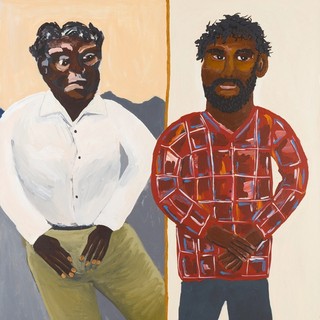
Vincent Namatjira, Western Aranda people, Australia b.1983 / Albert and Vincent 2014 / Synthetic polymer paint on linen / 120 x 100cm / Gift of Dirk and Karen Zadra through the Queensland Art Gallery | Gallery of Modern Art Foundation 2014. Donated through the Australian Government's Cultural Gifts Program / Collection: Queensland Art Gallery | Gallery of Modern Art / © Vincent Namatjira/Copyright Agency / View full image
Indigenous Australian Art
Artistic expressions from the world's oldest continuing culture are drawn from all regions of the country in the Gallery's holdings of Indigenous Australian artworks, especially the rich diversity of Aboriginal and Torres Strait Islander cultures and experiences in Queensland.